Generative AI Explained: ChatGPT, Gemini & the Future of Artificial Intelligence (2026)
Generative AI Explained: ChatGPT, Gemini & the Future of Artificial Intelligence in 2026
Introduction
Artificial Intelligence (AI) is evolving faster than ever, and one of the biggest technology trends today is Generative AI.
Unlike traditional AI systems that only analyze data, Generative AI can create new content, including text, images, videos, music, and even software code.
Tools like ChatGPT, Google Gemini, Microsoft Copilot, and DALL·E are transforming how people work, learn, and build products. In 2026, Generative AI is expected to become an essential part of education, business, healthcare, and software development.
This article explains what Generative AI is, how it works, its real-world applications, benefits, challenges, and career opportunities.
What is Generative AI?
Generative AI is a branch of Artificial Intelligence that focuses on creating new and original content based on patterns learned from large datasets.
Generative AI can produce:
-
Text (articles, emails, answers)
-
Images and illustrations
-
Videos and animations
-
Music and voice
-
Software code
Unlike rule-based systems, Generative AI models learn from data and generate human-like responses.
How Does Generative AI Work?
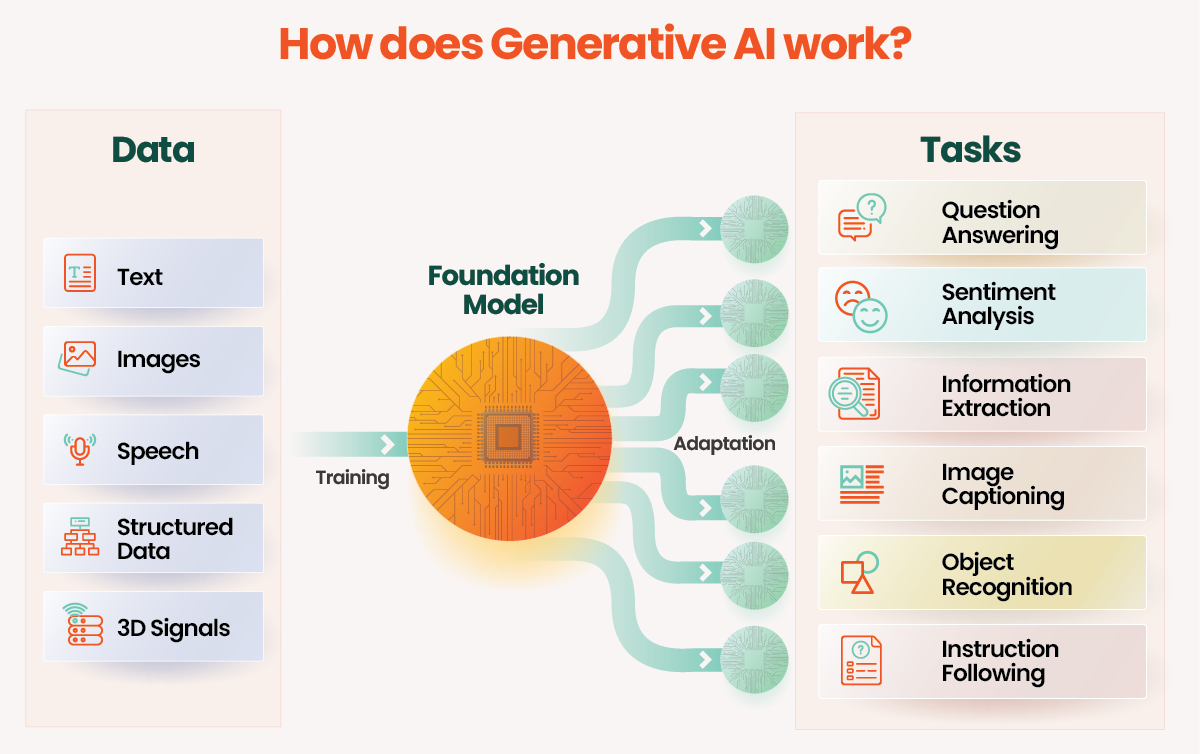
Generative AI works using Machine Learning and Deep Learning techniques, especially Large Language Models (LLMs).
Simple Explanation:
-
The AI model is trained on massive datasets
-
It learns patterns in language, images, or sounds
-
It predicts the most likely next word, pixel, or sound
-
It generates output that looks human-created
Popular architectures include:
-
Transformers
-
Neural Networks
-
Diffusion Models (for images)
Popular Generative AI Tools in 2026
ChatGPT
-
Used for writing, learning, coding, and problem-solving
-
Popular among students, developers, and professionals
Google Gemini
-
Advanced AI system by Google
-
Strong in reasoning, search, and multimodal tasks
Microsoft Copilot
-
Integrated into Windows, Office, and GitHub
-
Helps with productivity and software development
DALL·E & Midjourney
-
AI image generation tools
-
Used in design, marketing, and creative industries
Real-World Applications of Generative AI
Education
-
Personalized learning
-
Instant doubt solving
-
AI-generated notes and explanations
Software Development
-
Code generation
-
Debugging assistance
-
Faster development cycles
Healthcare
-
Medical data analysis
-
Drug discovery support
-
AI-assisted diagnosis
Content Creation & Marketing
-
Blog writing
-
Video scripts
-
Advertisement copy
Business & Finance
-
Data analysis
-
Report generation
-
Customer support automation
Benefits of Generative AI
-
Saves time and effort
-
Increases productivity
-
Reduces human errors
-
Enables creativity at scale
-
Makes technology accessible to beginners
Challenges and Risks of Generative AI
-
Data privacy concerns
-
AI-generated misinformation
-
Job displacement in some roles
-
Dependence on AI systems
-
Ethical and copyright issues
Responsible usage and proper regulation are necessary for safe adoption.
Generative AI Career Opportunities
Generative AI has created new job roles such as:
-
AI Engineer
-
Machine Learning Engineer
-
Prompt Engineer
-
Data Scientist
-
AI Product Manager
With proper skills, AI professionals can earn high salaries in India and globally.
Future of Generative AI
By 2026, Generative AI will:
-
Become more accurate and human-like
-
Be integrated into daily tools
-
Assist in decision-making
-
Improve creativity and innovation
AI will not replace humans completely, but people who use AI effectively will outperform those who don’t.
Conclusion
Generative AI is one of the most powerful technological advancements of our time. It is reshaping industries, careers, and education systems across the world.
Learning about Generative AI today will help individuals stay relevant, competitive, and future-ready in the evolving digital world.


Comments
Post a Comment