How Artificial Intelligence (AI) Started: History, Evolution, and Key Milestones
- Get link
- X
- Other Apps
How Artificial Intelligence (AI) Started: History, Evolution, and Key Milestones
Introduction
Artificial Intelligence (AI) is transforming the world today—from smartphones and chatbots to healthcare and agriculture. But AI did not appear suddenly. It has a long history that began decades ago with simple ideas, mathematical logic, and early computers. Understanding how AI started helps us appreciate how far technology has come and where it is heading next.
What Is Artificial Intelligence?
Artificial Intelligence refers to machines or software systems that can think, learn, and make decisions similar to humans. AI systems can:
-
Solve problems
-
Understand language
-
Recognize images
-
Learn from data
Today’s AI is powerful, but its roots go back to the early days of computing.
The Birth of AI: The Early Ideas (1940s–1950s)
The foundation of AI began in the 1940s, when scientists started thinking about whether machines could imitate human intelligence.
One of the most influential thinkers was Alan Turing, a British mathematician. In 1950, he proposed a simple but revolutionary question:
Can machines think?
He introduced the Turing Test, which suggested that if a machine could communicate like a human, it could be considered intelligent.
The Term “Artificial Intelligence” Is Born (1956)
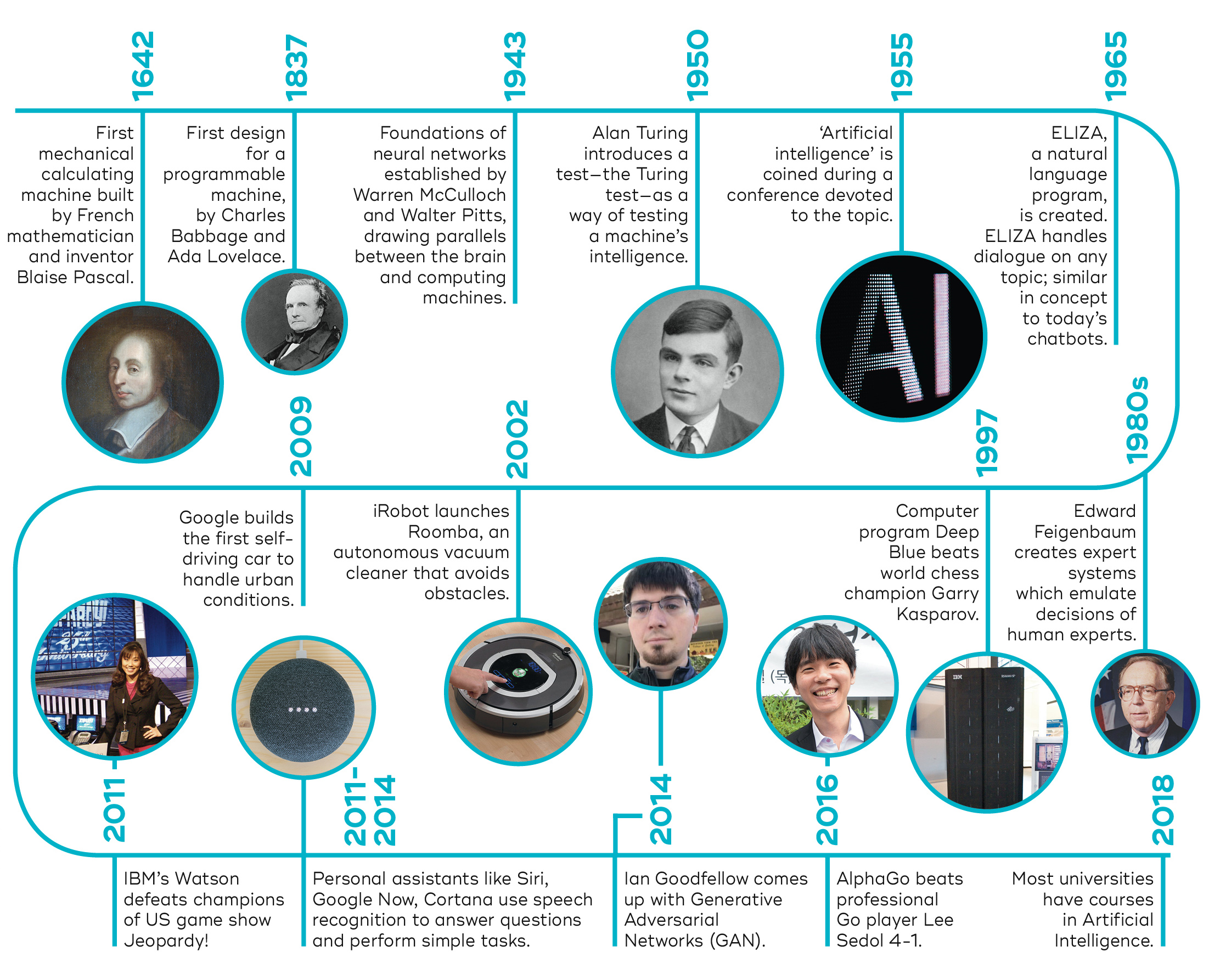
The term Artificial Intelligence was officially coined in 1956 at the Dartmouth Conference in the United States. Researchers believed that machines could soon:
-
Understand human language
-
Solve complex problems
-
Improve themselves
This moment is considered the official beginning of AI as a field of study.
Early AI Programs and Optimism (1950s–1960s)
During this period, scientists created the first AI programs that could:
-
Play chess
-
Solve mathematical problems
-
Prove logical theorems
Computers were slow and expensive, but expectations were very high. Many believed that human-level intelligence would be achieved within a few decades.
AI Winter: When Progress Slowed (1970s–1990s)

Despite early excitement, AI faced serious challenges:
-
Limited computing power
-
Lack of large datasets
-
Over-promising results
Funding reduced, and progress slowed. This period is known as the AI Winter, when interest and investment in AI declined significantly.
The Revival of AI (2000s)
AI started to rise again in the early 2000s due to:
-
Faster computers
-
The internet and big data
-
Better algorithms
Machine learning allowed systems to learn from data instead of being manually programmed.
The Rise of Modern AI (2010s–Present)
Modern AI took off with deep learning, which uses neural networks inspired by the human brain. AI systems can now:
-
Recognize faces
-
Translate languages
-
Drive vehicles
-
Generate text, images, and music
AI is now widely used in technology, healthcare, agriculture, education, finance, and global trade.
How AI Is Shaping the Future
AI continues to evolve rapidly. Future developments may include:
-
Smarter automation
-
Personalized education
-
Advanced medical diagnosis
-
Sustainable agriculture solutions
However, ethical use, data privacy, and responsible development remain critical.
Conclusion
Artificial Intelligence started as a simple idea: can machines think like humans?
From early theories and slow computers to today’s powerful AI systems, the journey of AI has been long and fascinating.
As AI continues to grow, understanding its history helps us use it wisely and prepare for a future shaped by intelligent technology.
- Get link
- X
- Other Apps


Great post!
ReplyDeleteThe history of AI is a fascinating journey from early theoretical ideas like Alan Turing’s work in the 1940s to the formal establishment of the field at the 1956 Dartmouth Conference. Since then, it has evolved through cycles of breakthroughs, setbacks, and major technological leaps that have shaped today’s generative systems. If you're interested in how modern AI is being applied in real-world software projects, this is a useful resource: https://www.cleveroad.com/ai-assisted-development-services/
ReplyDelete